
U.S.-Venezuela Oil Deal Has Latino Loyalists Turning Against Trump on Social Media
Even as four prominent Latino MAGA influencers took split stances on the issue, majority of comments on their posts suggest wide disapproval of the deal, and U.S.-Venezuela policy.
One month into the Trump Administration’s oil deal with Venezuela, DDIA is finding that even the most ardent supporters of the president have a limit to their loyalty.
Between August 28 and September 22, 2026, DDIA collected and reviewed posts from Emmanuel Rincón (Venezuelan based in Miami), Orlando Avendaño (Venezuelan based in Colombia), Eduardo Menoni (Venezuelan based in El Salvador), and Javier Negre (Spaniard based in Washington, D.C.), four of the most prominent conservative Spanish-speaking influencers that shape conversations on U.S.-related issues.
Emmanuel Rincón and Orlando Avendaño criticized the deal, while Eduardo Menoni and Javier Negre defended it.
Our team looked at 819 publicly visible comments in both English and Spanish on X and Instagram in response to two oil deal-related publications from each of the above individuals to gauge how Spanish-speaking social media users are reacting to these developments. Whether these narrative shapers took a supportive or opposing stance to the deal, most comments showed most engaged Spanish-speaking social media users are unhappy with the U.S. agreement with the Venezuelan authorities:
Key Takeaways
Criticism of the oil deal is prevalent in Spanish. 67% of the Spanish-language comments criticized Trump’s Venezuela policy or the oil agreement, 20% defended it, and 13% did not take a clear position. Comments in English (that represented 9% of the full sample) were evenly divided, with 40% against the deal, 40% defending it, and 19% not taking a clear position. Reactions were also analyzed separately by influencers to identify differences within the overall pattern.
Supportive framing by an influencer was not a guarantee of persuasion. Critical comments left on posts about the oil deal outnumbered supportive ones, even under influencers’ posts who voiced their support of the deal.
Criticism came from different political directions, from anti-Trump users to those who may still support the President but expressed skepticism of the deal.
There’s an emerging feeling of betrayal. Some of those who criticized the deal expressed previous support for Trump and a new sense of deception. This group ties their support to elections in Venezuela, sovereignty, and tangible economic results.
On August 28, President Donald Trump announced an oil agreement with Venezuela. As part of the deal, private consortium North American Blue Energy Partners (NABEP) gained exclusive exploitation rights to 17 oil fields containing an estimated 65 billion barrels of crude. In return, the U.S. government secured a 35% equity stake in NABEP’s parent company and a guaranteed 20% share of production. NABEP is owned by Alejandro Betancourt, a known "bolichico," a term for well-connected young elites who built fortunes on government contracts under Hugo Chávez (see our past reporting in REDESCover and subscribe here).
Influencers Who Challenged the Deal
Emmanuel Rincón
Emmanuel Rincón, who has 619,000 followers on X and 302,000 followers on Instagram, has, for years, amplified pro-Trump narratives and has previously been fact-checked for spreading misinformation, emerged as the most notable vocal critic of the deal among the conservative voices analyzed for this study.
DDIA tracked his first prominent break with the White House on August 28, the day Trump announced the agreement on Truth Social. That day, he posted, in English, that “Trump chose to negotiate a deal with Delcy Rodríguez behind the backs of the Venezuelan people.” The post generated over 8,000 likes, and was shared over 3,000 times.
Since then, Rincón has continued criticizing both the agreement and Trump’s praise of Venezuelan leader Delcy Rodríguez, while broadening his criticism to the White House immigration crackdown in Doral, Florida, and Trump’s $5,000 check campaign promise.
Since the oil deal came to light, he has not posted any post supporting Trump. One year ago, within the same time period, he had published 190 posts supportive of the U.S. president.
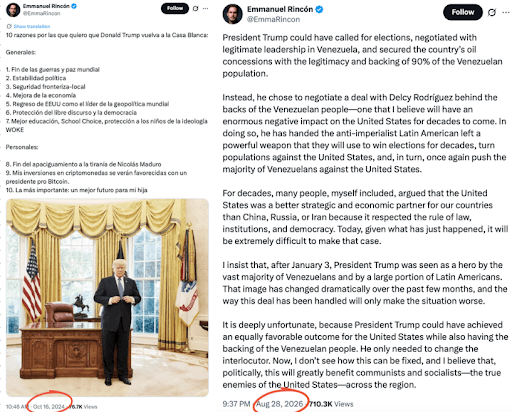
Rincón’s criticism, based on the two posts we analyzed, found considerable support among the commenters in his sample. Of the responses reviewed across these posts combined, 55% aligned with his objections to Trump’s Venezuela policy or the oil agreement, compared with 16% that defended the administration’s approach. The remaining 29% did not express a clear, discernible position on the deal.
Some of Rincón’s English-language posts were amplified more than once by right-wing Indian-American commentator Dinesh D’Souza, showing how a Latino influencer can reach beyond Spanish-language audiences and enter the wider MAGA conversation.
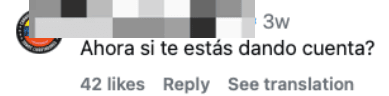
Important to note: We analyzed an English-language post from Rincón to see if there was any difference in the reactions by language. We found that English-language commenters leaned toward defending Trump and challenging Rincón’s criticism of the president and the deal, while Spanish-language commenters overwhelmingly supported criticism of the administration’s policy. English-language commenters also attacked Rincón, with phrases like, “You should be thanking Trump and US. You’re welcome” and, “I hope your visa gets revoked.”

Orlando Avendaño, a senior editor at the Texas-based conservative bilingual outlet Voz US (founded by Orlando Salazar, former vice chair of the Republican National Hispanic Assembly) has 348,000 followers on X and 85,000 followers on Instagram. Back in January, he had publicly urged followers to “trust the plan” shortly after former Venezuelan leader Nicolas Maduro’s capture, adding that “we can count on President Trump.”
After the oil deal was announced, however, he changed stances and began to repeatedly use his social media to amplify opinions critical of Trump’s Venezuela policy. He has not published messages defending the agreement.
Influencers Who Supported the Deal
Eduardo Menoni
Eduardo Menoni has long been one of the loudest Latino pro-Trump voices on X, where he has 1.1 million followers. He has been listed among the creators with the most fact-checked Community Notes in 2025, and a key foreign actor who generates more Google searches within the U.S. than Avendaño, Negre and Rincón, according to Google Trends data collected from the past two years. Menoni has also been amplified on X by MAGA influencers Joey Mannarino (who describes himself as a political commentator working with right-wing movements in the U.S. and the European Union) and Valentina Gomez (far-right activist and social media personality who ran in the GOP primary for Texas’ 31st Congressional seat). On Instagram, Menoni has 495,000 followers.
When it comes to the oil deal, Menoni has been actively defending the agreement as a win for both countries. He argues that Rodríguez has been “dominated” (domada) by Trump, and says “thank you” to the United States at the end of an Instagram video.
But despite his support and the number of publications about the oil deal (10 since the announcement), 54% of the comments left on his publications and analyzed by DDIA criticized the agreement, 40% supported it, while the remaining 6% did not reveal a clear position on the agreement.
Critics interacting with Menoni online described the terms of the oil deal as a surrender of Venezuelan resources, and doubted that oil revenue would improve daily life. They also questioned Rodríguez’s legitimacy and demanded elections.
Those who defend the agreement, portray it as a path to investment, production, and economic recovery in Venezuela.
Javier Negre
Javier Negre faced a much sharper reaction. Of the 221 comments reviewed under Negre’s oil deal-related posts, 72% criticized the agreement or his framing of it, 11% expressed support, while 16% did not express a clear opinion. 23% of those who criticized the deal also attacked Negre directly (mainly on X) accusing him of opportunism, propaganda, or helping rehabilitate Rodríguez’s image.
Negre is the current owner of Argentina-based La Derecha Diario and host of a Spanish-language channel on the conservative outlet Real America’s Voice. He has cultivated a close relationship to the White House, has called Delcy Rodríguez “pragmatic,” suggested Venezuelans should welcome the oil deal, and warned critics that they were “playing with fire” by opposing U.S. strategic interests. Negre has 440,000 followers on X and 491,000 on Instagram.
Negre has been facing criticism by Venezuelan users and renewed media scrutiny since he gained rare access to interview Delcy Rodríguez in Venezuela back in June and began attacking opposition leader María Corina Machado.
Political Loyalty Has Limits
These findings suggest Latino loyalty to Trump has limits. Rincón and Avendaño broke ranks to criticize a policy they seem to believe threatens their home country. Their followers largely supported them, which may suggest that homeland ties can override partisanship in certain situations.
On the other hand, influencers who maintained the White House narrative did not necessarily bring their audiences with them. Menoni and Negre defended or normalized the agreement, yet both faced substantial criticism from followers who viewed it as a betrayal of Venezuela’s democratic aspirations.
Methodology
DDIA analyzed 819 visible comments from initial reactions to X and Instagram posts by Emmanuel Rincón, Orlando Avendaño, Eduardo Menoni, and Javier Negre regarding the oil deal. Each comment was categorized by its stance on the deal, reaction toward the influencer, and the primary driver of criticism. Percentages describe these specific comment samples and should not be interpreted as representative estimates of the influencers’ entire audiences.